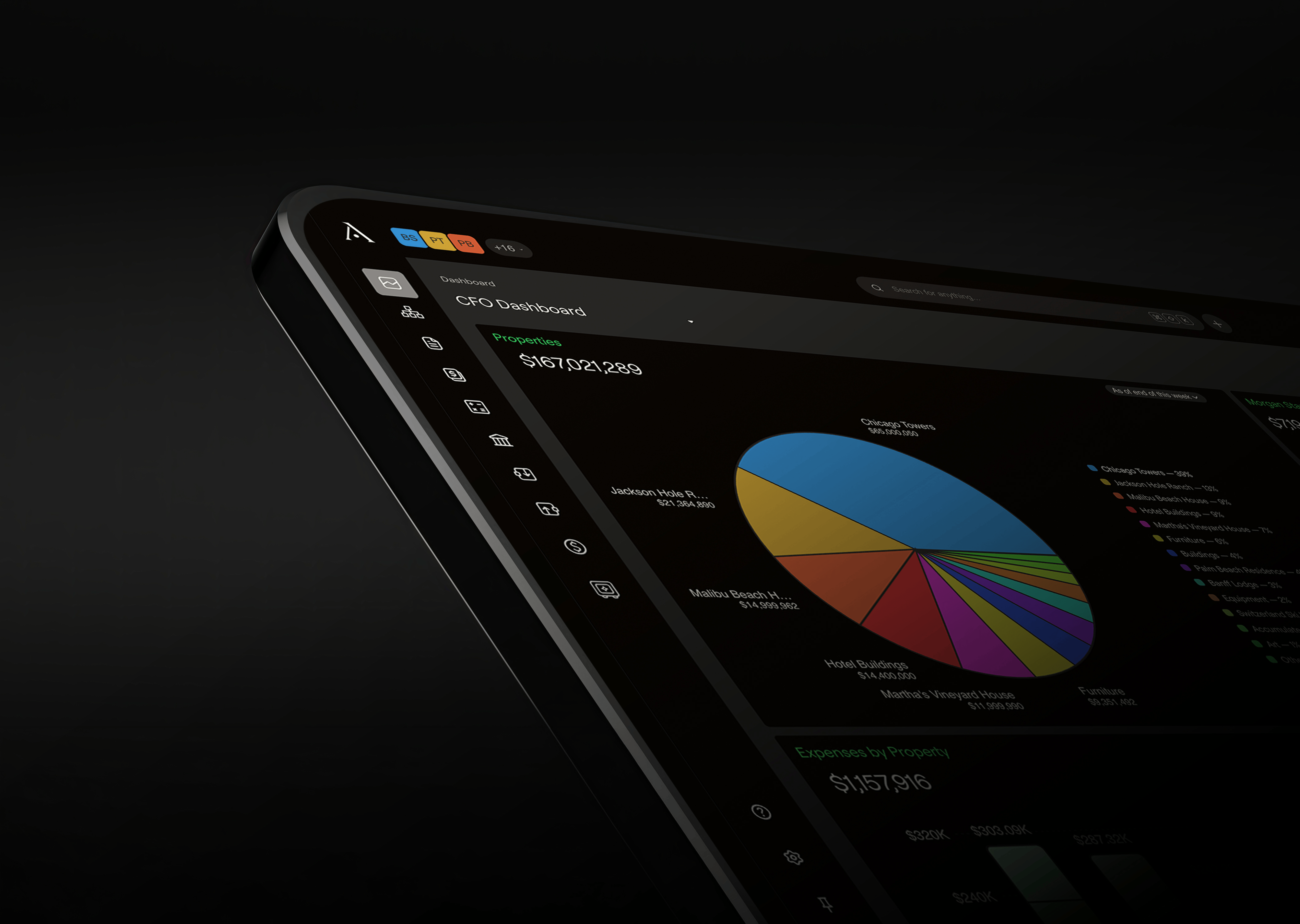
Yes. Asseta is a purpose built family office general ledger platform designed to unify investments and accounting. Asseta is built to replace QuickBooks for family offices that have outgrown single-entity accounting. Unlike QuickBooks, which was designed for small businesses, Asseta is a purpose-built general ledger and investment platform that handles the complexity of multi-entity, multi-currency family office operations.
With Asseta, you can:
- Integrate banking, investments, and accounting into one platform
- Consolidate across dozens of entities in real time
- Eliminate manual spreadsheets and workarounds
- Gain audit-ready books with family office–specific reporting
General FAQs
Yes — and a modern one. A general ledger is the source of truth behind every transaction: assets, liabilities, equity, revenue, expenses, every debit balanced by a credit. It's what turns raw activity into financial statements you can actually act on — spotting trends, managing budgets, staying compliant. Asseta builds that foundation for the complexity of a real family office.
General FAQs
Yes. Transactions between entities within your organization are automated end to end with no manual reconciliation, no guesswork. Asseta reconciles inter-company accounts automatically, keeping every entity accurate and audit-ready.
General FAQs
Yes, you can import historical data. For most family offices, Asseta goes live within 8–12 weeks with that timeline dependent on the state of your data, your systems, and your team's bandwidth. From day one, Asseta's CPAs, engineers, and customer success experts work alongside you for a smooth migration and a fast path to value.
General FAQs
Yes, this is part of Asseta’s native offering. Tag transactions and balances by fund, entity, family member, asset class, investment vehicle, project, or any custom dimension that matters to your office. Slice the data your way, run reports at any level of granularity, and see the full picture with no spreadsheets required.Your accounting should reflect the real complexity of your portfolios. With Asseta, it finally does.
General FAQs
Yes. With Asseta you can build tailored financial reports with filters, custom groupings, calculated fields, and dimensional analysis, with no engineering ticket required. Combine tables, charts, and KPIs into dashboards configured by role, entity, or preference. Or start from templates built for family office summaries, GP/LP performance, and investment allocation. Save, schedule, and share with any stakeholder, internal or external.
General FAQs
Absolutely, one click exports every report. You can export Excel with formulas and formatting intact for deeper analysis or PDFs for a polished presentation. Automate the distribution, too, with scheduled exports straight to email or shared folders.
General FAQs
Yes. Tailored reporting, a unique chart of accounts, custom integration mapping and additional support are part of the service Asseta builds around your office, during onboarding and beyond.
General FAQs
We are always optimizing the experience to ensure you have the most modern family office financial solution. Product updates happen quarterly at minimum, and we ship new features and enhancements on a regular cadence, keeping the platform ahead of the industry and in front of what your office needs next.
General FAQs
Yes, Asseta is SOC 2 Type II compliant and independently audited. That means rigorous standards for data encryption, access controls, system monitoring, and operational security are built to protect the trust your families place in you. Visit our Trust Center to see our compliance status in real time.
A full library of reports are ready, built for multi-entity, multi-asset complexity from day one:
- Consolidated and entity-level balance sheets and income statements
- Trial balances
- General ledger reports with full drill-down
- Variance and budget-vs-actual analysis
- Reports by any dimension you configure: asset class, family member, fund, and beyond
Every report supports dimensional filters, date ranges, and comparison periods, so you can zoom from the boardroom view to the granular detail in a click.
Yes, Asseta scales with the financial needs of your office.
For single-family offices, Asseta is the modern general ledger and investment platform that retires the spreadsheets, consolidates every entity, and gives you real-time visibility across all your assets and accounts.
For multi-family offices, Asseta supports multiple client structures, inter-company accounting, and consolidated reporting, all with the security, permissioning, and transparency your families expect.
One family's wealth or many, Asseta gives your family office the clarity and control to run accounting, investments, and operations from a single platform.
General FAQs
Asseta is the only intelligent family office suite built to unify accounting, banking, and investments in a single system of truth. No generic software, no workarounds. It’s a platform designed around the way multi-entity, multi-asset family offices actually operate.
With Asseta, you gain:
- A modern general ledger built for family office scale
- Seamless integration across the systems you already use
- Real-time visibility and reporting across every entity
- A partner that moves as fast as the industry does
With Asseta you’re choosing clarity, control, and a team focused entirely on your success.
On average, Asseta takes 8–12 weeks to go live, and every step is guided. Timeline depends on the state of your data, your technology needs, and your team's bandwidth, but you're never navigating it alone. Asseta's CPAs, engineers, and customer success team work directly alongside you from day one.
General FAQs
Yes. We bring our whole team behind you so you can move quickly ahead. Our team brings 50+ years of financial software management to your team. You get direct access via Slack, email, and scheduled calls, with response times under an hour. When you need us, we're already there.
General FAQs
Yes. You can configure required dimensions by transaction type, entity, or account, and Asseta keeps every entry complete and accurate, always prompting users for missing fields before anything posts. Consistency is built in.
General FAQs
Yes. Charts of accounts are fully customizable. Add, edit, or deactivate accounts, build custom types and subcategories, and structure your chart to match how your office actually works, whether that's family office standards, investment firm structures, or operating business needs. Changes reflect in real time across every entity.
General FAQs
Yes. Asseta integrates seamlessly with QuickBooks and has 15K+ direct integrations with financial tools and institutions. You can move your historical data over cleanly as you upgrade to multi-entity management and real consolidation.
General FAQs
Our support is comprehensive, and always within reach. Our team is available by phone, email, and a dedicated Slack channel. You are also backed by tutorials, FAQs, and community resources built to help your team get the most from the platform.
Yes. Asseta is built to support GAAP principles at every level through accrual-based accounting, audit trails, a dimensional chart of accounts, and proper revenue recognition workflows.
Compliance is a partnership and no platform guarantees GAAP-compliant outcomes on its own. Your finance team (controllers, accountants, CFOs) will need to ensure the family office processes align with GAAP standards. Our job is to make that work faster, easier, and more reliable.
General FAQs
Your data is hosted on a secure, enterprise-grade infrastructure in the United States, via AWS. Every byte is encrypted in transit and at rest, protected by strict access controls. Your family office finances deserve nothing less.
General FAQs
Yes, all asset classes including public and private investments.
General FAQs
Yes. Dashboards and saved reports are per‑user, and you control what data each role can see; C‑suite, AP, principals all see different views.
Reporting, Dashboards & Net Worth
Yes. Each entity runs a full double‑entry ledger, but reporting can be grouped (e.g., by family, fund, real estate group) for instant consolidated P&Ls/BS.
Core GL & Multi‑Entity Accounting
Yes. Many clients’ external accountants have restricted logins to handle reconciliations and reporting.
Implementation, Services & Support
Yes. External roles can be set up with read‑only or narrow write access limited to specific entities/modules.
Permissions, Security & Compliance
Yes. In Asseta, family members are first‑class dimensional objects, so they can be investors across entities and you can run per‑person statements.
Partnership, Trust & Fund Accounting
Yes. Net worth dashboards are standard and can be distributed by any time metric via email. Some clients run weekly snapshots for principals while staff work with real‑time data.
Reporting, Dashboards & Net Worth
Yes. P&L can be allocated by partner in real time, even as percentages change, because the cap table is time-aware and event-driven.
How it works:
- Effective-dated ownership: Every ownership change (admission, dilution, secondary, reallocation) is recorded with an effective date/time.
- Continuous allocation engine: P&L is allocated across partners based on the ownership state at the moment the revenue or expense is recognized.
- No retroactive distortion: Historical P&L remains locked to the ownership that was valid at that time unless an explicit restatement is triggered.
Partnership, Trust & Fund Accounting
Yes. Line items can be allocated across entities and dimensions (properties, family members, departments) with saved templates for recurring allocations.
Banking, Cash Management & Bill Pay
Yes. Cleaned GL data can be exported or pulled via API into tools like Sift/Excel without needing manual rework.
Reporting, Dashboards & Net Worth
Yes. Family member roles are common; each person sees only their relevant entities and dashboards.
Permissions, Security & Compliance
Yes. Asseta models omnibus pools and uses dimensions to allocate to underlying client families daily.
Partnership, Trust & Fund Accounting
You can do either. Asseta has a full AP module and a bi‑directional Bill.com integration so some firms keep Bill.com for payments and let Asseta own the GL.
Banking, Cash Management & Bill Pay
Yes. General Ledger is the foundation; AP/bill pay, banking, collections, and then investments can be layered on as you go.
Implementation, Services & Support
Yes. Funds are entities with investor dimensions. You can see fund‑level and investor‑level views without re‑implementing a separate fund‑admin system.
Partnership, Trust & Fund Accounting
Yes. Asseta produces real-time consolidated reports with click‑through from top‑level lines down to journals and source documents.
The platform can produce Balance Sheet /Profit & Loss / Cash Flow reports across all your entities with any dimension layered over the report.
Reporting, Dashboards & Net Worth
Yes. Dashboards can show consolidated and per‑entity cash, plus projected cash based on scheduled bills and known flows.
Banking, Cash Management & Bill Pay
Yes. Budgets and scheduled bills can be turned into forward‑looking cash reports; this is used primarily for treasury planning.
Banking, Cash Management & Bill Pay
Yes. Some families get periodic PDFs or Excel exports while CFOs have live access; Asseta supports both modes and access can be granted anytime to any user with advanced read/write permissioning.
Reporting, Dashboards & Net Worth
Yes. Asseta’s dimensional model lets you pivot by any tag (family member, asset class, geography, strategy, property) without exporting to Excel. Think of it as a pivot table on steriods.
Reporting, Dashboards & Net Worth
Yes. There is a collections module (or near‑term roadmap) that tracks cost, FMV, insurance value, provenance, and location.
Reporting, Dashboards & Net Worth
Yes. Regulator/auditor roles can get narrow, read‑only reports with the dimension/period breakdowns they require.
Reporting, Dashboards & Net Worth
Yes. Accounts can be grouped into custom report rows and filtered by dimensions (e.g., “only hotel properties”) and saved as templates.
Reporting, Dashboards & Net Worth
Yes. FMV from Addepar/others and cost/tax books in Asseta can be presented side‑by‑side in net worth statements and dashboards.
Investment Data, Performance & Integrations
Yes. Asseta has a single multi‑entity GL with a shared master chart, so you can view each entity separately and run instant consolidated reports without logging in/out of separate instances.
Core GL & Multi‑Entity Accounting
Yes. Filters by family branch or generation are common; each group can have its own saved “G2 dashboard,” etc.
Reporting, Dashboards & Net Worth
Yes. Asseta tracks ownership changes over time and allocates income/expenses accordingly.
Partnership, Trust & Fund Accounting
The near‑term approach is to surface historical call patterns and give clients tools to define assumptions, while being explicit that alt behavior is not fully predictable.
Investment Data, Performance & Integrations
Yes. Asseta exposes data via APIs/exports so external BI tools can consume it; this is part of the pitch versus Allvue + Power BI.
Investment Data, Performance & Integrations
Yes. Most clients move from manual entry to automated feeds with categorization rules and occasional CSV uploads only for edge cases.
Banking, Cash Management & Bill Pay
Yes. Pricing and UX are optimized so you can maintain hundreds of low‑activity entities cheaply while focusing operational work on the ~20–40 active ones.
Core GL & Multi‑Entity Accounting
The data model allows non‑equity “profit share” style allocations; some bespoke carry math still needs configuration vs a one‑click waterfall.
Partnership, Trust & Fund Accounting
Yes. Asseta has repeatable migration playbooks for QBD/QBO; the team maps TBs and trial imports, then validates balances with your staff.
Core GL & Multi‑Entity Accounting
Yes . Direct custodian connectivity is being built out (JP Morgan, Goldman, UBS, Morgan Stanley, Schwab, etc.), with a 1–1.5 year horizon for deep tax‑lot feeds.
Investment Data, Performance & Integrations
Yes. Those integrations are in various stages. Today you can exchange data via files/APIs, and deeper, certified integrations are on the roadmap.
Investment Data, Performance & Integrations
Yes. Several clients leave operating companies on ERP/Yardi and feed monthly TB summaries into Asseta for consolidated family reporting.
Core GL & Multi‑Entity Accounting
Yes. Most family offices don’t run full GAAP and Asseta supports cash/tax basis as primary with selective accrual (e.g., for specific entities or accounts).
General FAQs
Yes. Asseta supports this and it's a known use case, and the cap‑table + allocation engine is built for frequent ownership updates.
Partnership, Trust & Fund Accounting
Yes. Entities can be grouped into arbitrary hierarchies so reports can be run at any level (e.g., “all hotel holdcos,” “all G2 trusts”).
Core GL & Multi‑Entity Accounting
Yes. Asseta collapses overly granular accounts into high‑level headers and uses dimensions (properties, family members, strategies, etc.) for detail.
Core GL & Multi‑Entity Accounting
Yes. For family‑office use cases, Asseta positions as a GL‑centric platform purpose‑built for family offices, typically with lower complexity and TCO than horizontal ERPs.
Core GL & Multi‑Entity Accounting
Basic GP/LP ownership and allocations work today; full waterfall modeling is on the roadmap but not fully automated for every structure yet.
Partnership, Trust & Fund Accounting
For many clients, yes via integrated sources (Addepar, etc.); where you only have transaction streams, Asseta can compute gains/losses but isn’t yet a full portfolio accounting engine.
Investment Data, Performance & Integrations
Yes. Each client has a named implementation lead (often Josh) who stays with them through setup and beyond.
Implementation, Services & Support
Yes. Asseta is a premier partner. You pull transactions and positions from Addepar and can also push reports/documents or summarized data back into Addepar.
Inbound (Addepar → Asseta)
- Positions, transactions, valuations, and reference data are pulled from Addepar.
- Asseta uses this as the source of truth for portfolio activity and NAV inputs.
Outbound (Asseta → Addepar)
- Asseta pushes derived outputs, not raw math:
- partner-level P&L and allocations,
- fund/entity rollups,
- reports and documents (e.g., capital statements, summaries).
- This keeps Addepar clean while reflecting Asseta’s calculations.
What “bi-directional” does not mean
- No circular overwrites.
- No competing valuation engines.
- Clear system-of-record boundaries.
Investment Data, Performance & Integrations
Yes. Every journal, configuration change, and approval is recorded with user/time stamps for full auditability.
Permissions, Security & Compliance
Yes. Training sessions are included, recorded, and focused on enabling clients to manage future entities and migrations themselves.
Your implementation specialist will manage and run all training sessions.
Implementation, Services & Support
Not 1:1 today. Asseta replaces the GL and much of the allocation logic; some firms keep an external admin for regulatory fund work.
Partnership, Trust & Fund Accounting
No. Today Asseta uses only Microsoft Vision AI for invoice OCR; no ChatGPT/Claude/Gemini are applied to customer data.
Customer data will never be trained on LLMs without the express written consent of the customer.
Permissions, Security & Compliance
Yes. Today Asseta generates NACHA files and supports in‑house check printing; direct ACH rails/virtual cards are on roadmap and some clients also keep Bill.com in the loop.
Banking, Cash Management & Bill Pay
Yes. Asseta supports BYOK so even Asseta staff can’t read client data. BYOK is offered via AWS Key Management Service (KMS).
Permissions, Security & Compliance
We do not natively support crypto and self-custody wallets today. However, we do support a Coinbase integration. Self‑custody/wallets are handled via manual or CSV entries today.
Investment Data, Performance & Integrations
Yes. Multi‑book plus multi‑value is explicitly part of the investments roadmap and already used conceptually for collections.
Investment Data, Performance & Integrations
Yes. Multi‑book was part of the initial design and many clients run a cash/tax book today and can add a fair‑value book for investment reporting later.
Core GL & Multi‑Entity Accounting
Yes. Multi‑currency and multi‑book are core to the application. Asseta supports 180+ currencies globally. FX rates come from Visa/Oanda with override capabilities, and reporting can be in functional or consolidated currency.
Core GL & Multi‑Entity Accounting
Yes. Multi‑period reports (e.g., 5‑year trend) and budget vs actual by account/entity/family member are supported once budgets are loaded.
Reporting, Dashboards & Net Worth
Yes. Statistical dimensions/accounts can track non‑financial metrics that then drive allocation and reporting (e.g., square feet for expense allocations).
Core GL & Multi‑Entity Accounting
Yes. Trust entities and beneficiaries can be modeled, and reports can show by trust, by beneficiary, and across generations.
Partnership, Trust & Fund Accounting
Yes. Asseta is built for multi-entity family offices and supports unlimited entities in a single, unified view.
You can run real-time consolidations across dozens of structures, drill down into individual entities, and automate intercompany transactions, all without spreadsheets or manual workarounds.
With Asseta, complexity becomes clarity.
General FAQs
You start with a model FO COA, map legacy accounts, consolidate where possible, then iterate with the client until it supports their reporting needs.
Implementation, Services & Support
Today: structured GL accounts and dimensions + data from providers like Arch/Canoe/Wellsite.
Longer‑term: automated PDF/K‑1 ingestion with AI powered document technology.
Investment Data, Performance & Integrations
Data is redundantly stored on AWS; the company is founder‑led with a multi‑founder cap table, long runway, and explicit anti‑PE stance to reduce platform risk.
We have a full Business Continuity and Disaster Recovery Plan viewable on our trust center: trust.asseta.ai
Permissions, Security & Compliance
Intercompany is posted as linked entries across entities and the system automatically eliminates those relationships in consolidated views without requiring a separate eliminations entity.
Core GL & Multi‑Entity Accounting
We help you triage. We recommend summarizing older years into monthly TBs, bring current year in detail, and keep the legacy system read‑only for “deep history.”
Implementation, Services & Support
Checks are tracked as open items; reconciliation workflows highlight outstanding payments versus cleared transactions.
Banking, Cash Management & Bill Pay
Pricing is primarily by family/household tier. View our pricing page for more info.
Pricing & Commercials
Very granular. Users can be limited by entity group, account ranges, modules, and even which dashboards/reports they can see or edit.
Read/write privledges can be granted to any entity, module or report.
Permissions, Security & Compliance
Implementation starts with designing a master chart, mapping each legacy COA into it, and using dimensions instead of endless subaccounts to simplify the structure. Our free Family Office Chart of Accounts template is a great place to start.
Core GL & Multi‑Entity Accounting
Invoices can trigger multi‑tier approval chains based on amount, vendor, category, or entity, with auto‑approval thresholds for small recurring bills.
Banking, Cash Management & Bill Pay
Using Microsoft Vision AI, Asseta reads amounts, vendors, dates, terms and line items from PDFs/emails, creates draft bills, and then learns from user corrections. Invoices can be scanned in seconds and mapped to entities, dimensions and stored in Asseta's Document Vault.
Banking, Cash Management & Bill Pay
There’s no hard limit. Client will often import is 2–3 years of monthly TB summaries plus current YTD transactional detail, with some clients bringing in 10–20 years.
Core GL & Multi‑Entity Accounting
The plan is API or SFTP ingestion of statements/transactions and mapping them into double‑entry accounting, using each provider as the source of truth for alts.
Investment Data, Performance & Integrations
Yes, Asseta is SOC 2 Type II compliant. We undergo independent audits to ensure our controls meet the highest standards for security, availability, and confidentiality. This includes rigorous practices around data encryption, access controls, system monitoring, and operational processes. Our compliance demonstrates our commitment to protecting sensitive financial data and maintaining the trust of our clients.
Please visit our Trust Center to see our compliance status in real-time.
General FAQs
Asseta is SOC 2 Type 2 compliant and prioritizes the security of your financial data with advanced encryption, regular security audits, and compliance with industry standards. Our platform uses multi-factor authentication and continuous monitoring to detect and prevent unauthorized access, ensuring that your financial information remains confidential and secure.
General FAQs
 Multi-entity partnership accounting
 Investments data aggregation
 Audit-ready from day one